A Lifelong Pain in a Woman's Body
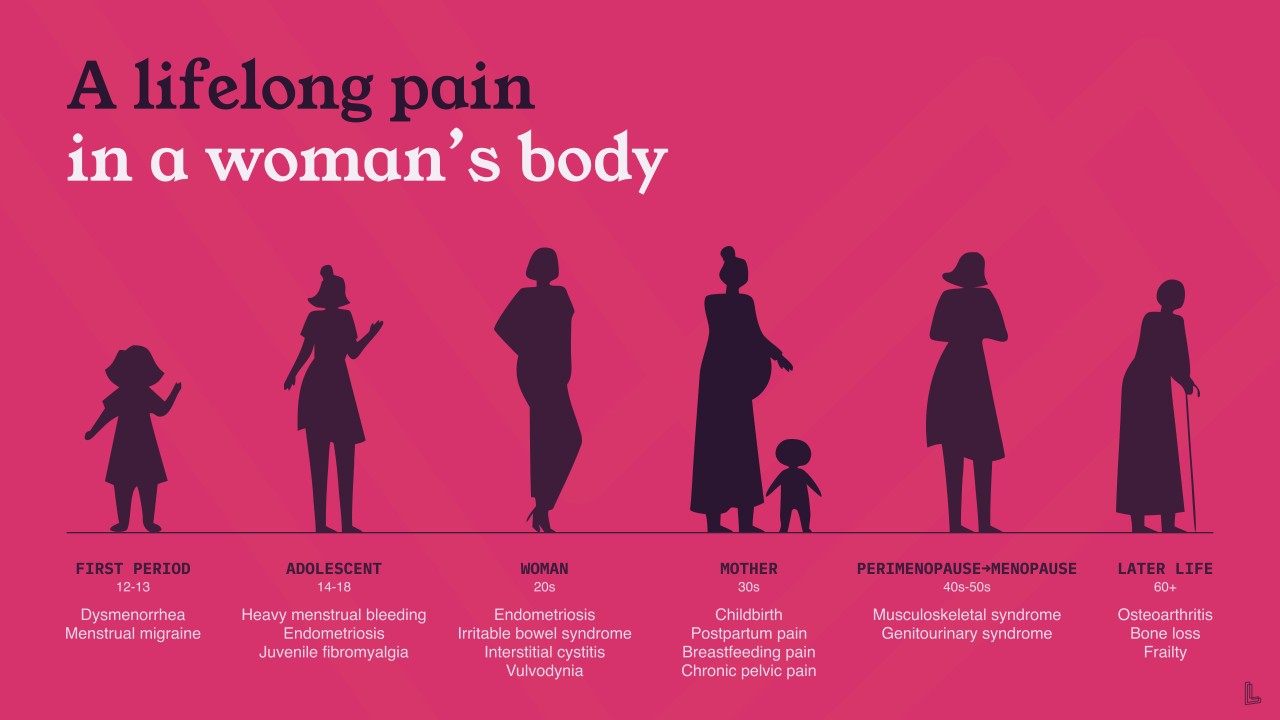
Women experience chronic pain disorders at least twice the rate of men.
For a very long time, when people thought about the pain a woman have to live with, they thought about childbirth. Not much besides that. Just as when people thought about women's healthcare, they thought about reproduction — and that was the whole category.
But reproduction is only one stage of a woman's life. If you sit down and look closely, you find that a woman's body can be in pain across almost her entire lifespan.
It begins with puberty and the first period. Persistent and unresolved pain arrives and may never fully leaves. Around the same years: menstrual migraine, dysmenorrhea, and fibromyalgia, which hits younger women hardest.
Through the reproductive years it multiplies. Irritable bowel syndrome (IBS). Interstitial cystitis. Fibroid pain. Vulvodynia. And the hardest piece to untangle — chronic pelvic pain, which can invovle three organs at once: the gut, the bladder, the reproductive organs. Episodic and unpredictable. Always a puzzle when it comes to diagnosis.
Endometriosis, and Polyendocrine metabolic ovarian syndrome (PMOS, formerly known as PCOS) are top causes of infertility. For some women, sex itself can be painful. So the pain is never only hers, but also her partners' and loved ones': when to try for a child, whether she can, and what treatment is even available to her.
Then childbirth, the part everyone knows. Pain for hours, sometimes days.
And almost no one mentions what comes after - postpartum recovery and breastfeeding. I once heard a woman on a podcast say she couldn't believe nobody had warned her that breastfeeding her baby would hurt that much. Nobody talks about it. The severe pain, seems to be just one of another normal thing that women need to get through, generation by generation.
Menopause is something finally gets talked about recently — though far less in developing countries. I remember my aunties complaining symptoms at a family gathering, and only then did my mom say anything about her own, which had happened years earlier. With some shame in it. And with emphasis on how she had managed to power through, how it was all normal.
And women face higher risk of pain again later in life. Osteoarthritis. Bone loss. Which compromise mobility, lead to frailty, and accelerate aging.
We seem to agree now that women's health goes well beyond reproduction and it runs the length of a life.
So does the pain.
Then I dug into the review article sex-specific mechanisms of chronic pain on Science Magazine, to understand how the mechanisms of chronic pain differ between women and men, at the level of cells and of whole systems.
The data is still limited and most of these studies were done in mice. But the direction is consistent: give a male and a female the same injury, and they differ in disease progression, pain sensitivity, and recovery. Which means decades of pain research done in male animals was describing half the picture and calling it the whole one.
Some things I picked up from the review article and found interesting:
- The fluctuation of ovarian hormones beginning at puberty appears to initiate many of these female-specific and female-prevalent pain conditions. women on oral contraceptives showed no difference in visceral sensitivity compared with men.
- The causes of pelvic pain are closely intertwined. 50% of women with interstitial cystitis/bladder pain syndrome (IC/BPS) and roughly 30% of women with irritable bowel syndrome(IBS) also have endometriosis, which makes both diagnosis and treatment hard. To solve this, we need interdisciplinary research approaches spanning multiple fields.
- Pain is processes differently across the nervous system in women and men. Some female-specific immune cells may play a neuroregulatory role, modulating chronic pain across different life stages, such as pregnancy.
- Male mice run pain through microglia; females through T cells. Pain resolution process is slower in women than men. Give androgen to female mice and resolution speeds up to male rates. A study in people after car accidents shows the same pattern — one of the few findings here with human data behind it.
- Migraine affects younger women two to three times more frequently than men. It peaks just before or during menstruation and starts at puberty — and it eases in the second and third trimesters of pregnancy, when hormones are high but steady.
- Some women live with chronic pain for decades and some never develop symptoms. Nobody knows why. But I'm optimistic and looking forward to future research and study can explain this one day. So I'll end where the article ended:
"Women are desperately waiting for concrete answers that might help eliminate the common 'all in your head' approach to their illnesses, shorten the long wait between symptoms and diagnosis/treatment, and ultimately provide mechanism-based strategies for disease treatment."
The full article: Archana Venkataraman, Élora Midavaine & Holly Ingraham. Sex-specific mechanisms of chronic pain. Science Magazine 394(6819):69-74, 2026. https://doi.org/10.1126/science.aeh4468
Originally published on LinkedIn.