Why Employees Aren't Using AI the Way Leadership Hoped: Three Things I've Observed
During a conversation with Leading People course professor at University of California, Berkeley, Haas School of Business, Erica Bailey (P.S. she is awesome) shared a story from research she did with a consulting firm, and I couldn't stop thinking about it.
The firm has a heavy writing culture, a lot like Amazon, where I worked most recently. Peers write feedback to peers. Managers write feedback to their reports, and reports write feedback back up to their managers. All the time.
What she found was that everyone was using AI to write those feedback reports. And by the end of the day, nobody was reading any of it.
Leadership got nervous. If her research concluded that AI wasn't truly helping productivity, that would be pretty awkward for a firm whose business is selling AI transformation to other companies.
I've been sitting with that story next to a few observations from my own years at different companies, and three patterns stood out to me.
1. AI cannot fix a process that was already broken
Honestly? I don't think employees using AI to write feedback is a bad thing at all.
I had a similar writing ritual at Amazon. Writing all those docs takes real time and energy during a normal workday, and a lot of them aren't connected to your actual deliverables or results. For people who don't enjoy writing, or aren't confident writers, it's genuinely painful. I've had nights where I struggled so much with my promotion documents that I had to pour a glass of Scotch just to find the words.
So let me ask the uncomfortable question: before AI, how honest was that feedback really? In my experience, maybe 30% of it was true. No one would tell you they wrote those reports with their whole heart, especially when you're asked to write feedback too often, or when the workload is heavy and the deadlines are tight. That was true long before AI existed.
So when a company says nobody writes or reads the feedback anymore, I want to ask: did they truly write what they meant before?
I actually love having AI handle this kind of work. It's a lifesaver for me. The problem was never the tool. The problem is that we built a process that didn't make sense, and AI just made it obvious.
Moreover, AI cannot fix a bad manager or a bad culture either. Only a manager or team leader can create a psychologically safe environment. And people only do their best work when they feel safe, respected, and acknowledged.
2. We measure the wrong thing, and forget someone has to sign off
I've watched engineering leadership set goals like: now that you have AI, write 20% more code this month than last month. Then 20% more the month after that.
If you understand even the basics of coding, this doesn't make sense. Code is instructions you give a machine, and the quality matters enormously. Lines of code should not be the only output measurement. And the more complex a product gets, the more thought the infrastructure needs, which means more discussion, more debate, more collaboration. AI doesn't make that part disappear.
I see the same thing on the design side. A colleague vibe-coded a prototype from a product requirements doc, got excited, and said the design was basically done and just needed the designer to approve it, as if that would only take 2 hours.
But I still need something like 20 hours.
Here's why. A vibe-coded prototype won't answer these questions that are supposed to be thoughtfully sorted out before visualizing solutions:
- What problems are we solving? Which one is the most important and urgent?
- Why are we solving it at all?
- What does the user actually need here, and what are not needed here?
- Based on my domain knowledge, are there any other better solutions?
- How does this solution connect to the future vision of the product or platform?
Those still take investigation, careful thinking, and user validation. As a designer who cares, that's the part I've always struggled to defend, because it's hard to explain why good work needs time.
And there's one more piece that often gets ignored: AI can do the work, but it can't take the responsibility. AI can produce, but someone still has to sign off. To put my name behind it, I have to examine what AI produced properly, and that doesn't take significantly less effort than if a human had built it from the start.
3. We expect one AI tool to work for every role
I want to be clear that I'm not saying AI doesn't improve productivity. It does. But how it helps looks completely different depending on the job.
For a PM, a huge amount of the work is reading and writing documents, so a language model is enormous leverage. Similar for a software engineer who writes lines of code.
For a designer, doc writing is a small slice. The hard parts are staying synced with what's happening now and what's planned next across every team your feature touches, thinking systematically enough to keep mental models and interaction patterns consistent, understanding what the user is truly frustrated by, exercising judgment, and having good taste. An AI chat window can help with some of that, but not much.
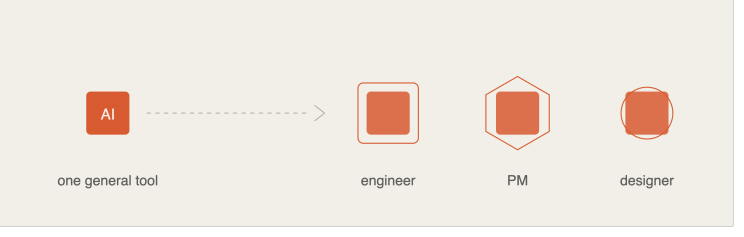
So when leadership asks why employees aren't using AI the way they hoped, I think it's because the tools we have today are pretty single-layered. One shape can't fit every kind of work. Different roles need different kinds of help, and different tools to produce better results.
That's a design problem, which is actually the exciting part. The gap between a general AI tool and something that genuinely changes how a designer, a nurse, a supply chain planner, or a factory engineer works still widely exists, and mostly wait us to build the solutions.
So if your AI rollout doesn't seem to be working, I'd ask three questions before blaming AI: was the process working at the first place, were we measuring the right thing, and did we provide people the right tool for their specific job?
Originally published on LinkedIn.